
FIRST KITESURF JUMPS: A STEP-BY-STEP APPROACH
Jumping is probably one of the most exciting stages of your progression in kitesurfing. Leaving the water, staying in the air for a few seconds, then landing smoothly is the feeling that takes you from learning the basics to pure enjoyment. But jumping is not something you can just improvise. A poorly prepared first jump often ends in a hard landing, and that is exactly what we want to help you avoid.
This guide covers the essential prerequisites, breaks down the basic jump step by step, explains the key safety rules, and shows you how to progress towards bigger and more advanced jumps. The idea is not to try it alone, but to understand how a jump works so you can practice it more effectively with your instructor.
WHAT SKILLS DO YOU NEED BEFORE YOU START JUMPING IN KITESURFING?
Before you start thinking about jumps, you need to be fully independent on the water. Trying to jump too early is one of the main causes of hard crashes. If your riding is not solid yet, most of your attention goes into controlling the kite and the board, leaving too little focus to manage a jump safely.
Before attempting your first jump, you should be comfortable with three key skills:
- Riding upwind, so you can get back to your starting point and avoid drifting downwind during your attempts.
- Riding in control in both directions at a manageable speed, without feeling tense or struggling to stay balanced.
- Knowing your wind window inside out and being able to bring safely the kite to 12 o’clock
If you are not comfortable with all three, it is better to work on your riding first. A kitesurfer who is confident riding upwind and controlling the kite will learn to jump much faster and more safely than someone who rushes into it.
HOW TO LAND YOUR FIRST KITESURF JUMP, STEP BY STEP
The basic jump relies on a sequence that is easy to understand but takes practice to get right: edge properly, send the kite towards 12 o’clock, sheet the bar in and out, take off, then redirect the kite in your riding direction for a smooth landing. Here is the step-by-step technique our instructors teach.
- Build up speed and find a solid edge. Ride at a good pace with a stable body position and firm pressure through the board. This edge will act like a spring for your take-off.
- Edge harder and sheet in. Just before take-off, increase the pressure on your edge as if you were resisting the pull of the kite. This builds up the energy that will send you upwards.
- Send the kite to 12 o’clock and sheet out the bar. With a quick, controlled movement, send the kite towards the top of the wind window, around 12 o’clock, while sheeting the bar in and out. This upward movement creates the lift that pulls you off the water.
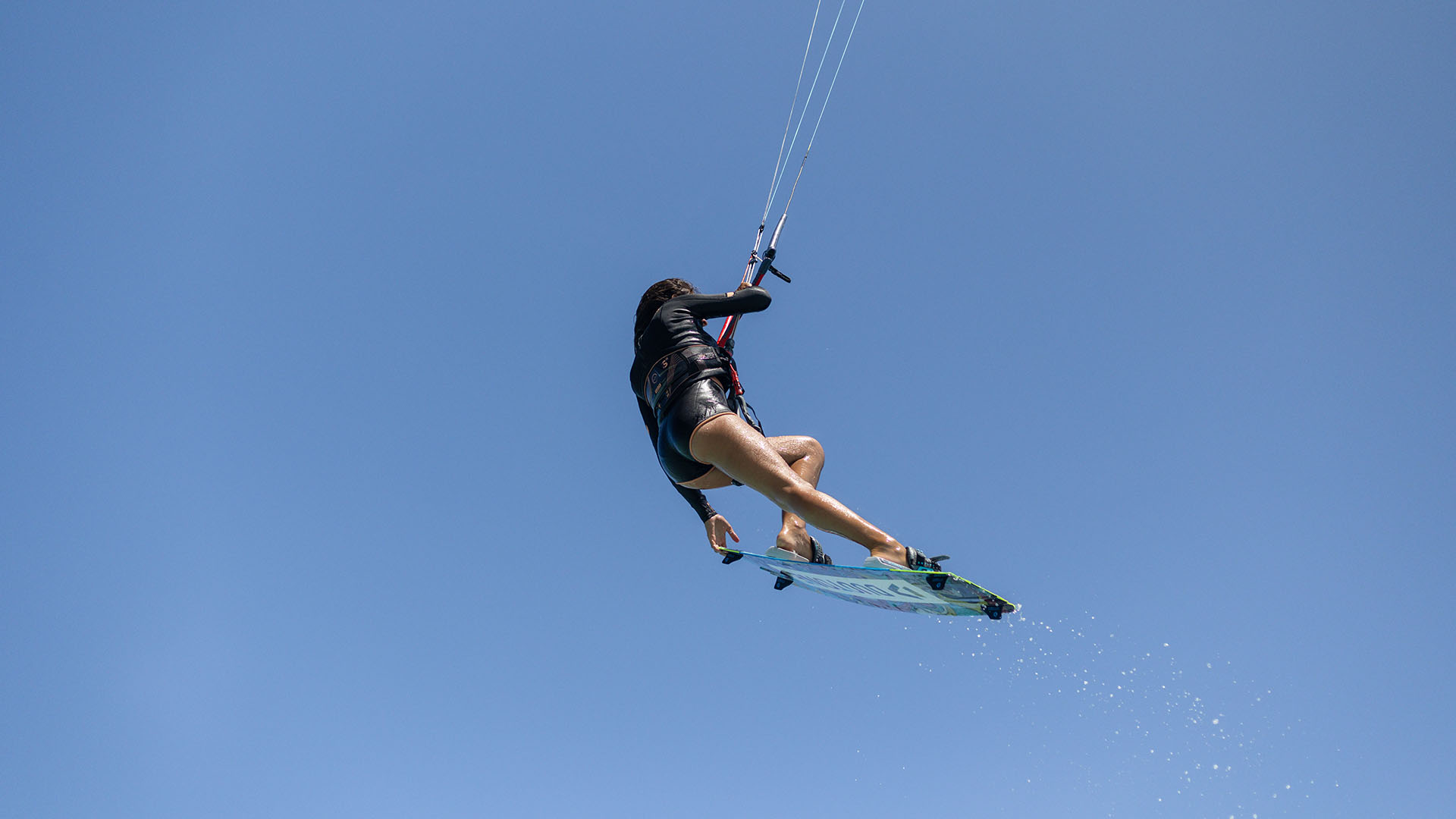
- Take off and stay engaged. As the kite lifts you, gradually release the pressure through your legs and let yourself rise while keeping your core engaged. Stay relaxed and keep your eyes on the horizon.
- Redirect the kite for landing. As you come back down, steer the kite back in your riding direction. This forward pull softens the landing and helps you ride away smoothly with the board pointing in the right direction.
At first, aim for very small jumps. Just a few inches off the water is enough to get the timing and coordination right. Height will come naturally once the technique feels comfortable. A clean, controlled landing, not height, is what makes a jump successful.
HOW TO JUMP SAFELY IN KITESURFING
Safety is essential if you want to keep jumping fun and progress with confidence. A few simple principles can significantly reduce the risk of hard landings and injuries.
First, choose the right spot: deep, open water with no obstacles or swimmers around, and steady wind rather than gusty conditions. Unstable conditions can make your jumps unpredictable. Also, never use a bigger kite just because you want to jump higher. An overpowered kite can pull you too aggressively and lead to hard landings. Always choose the right kite size for the conditions.
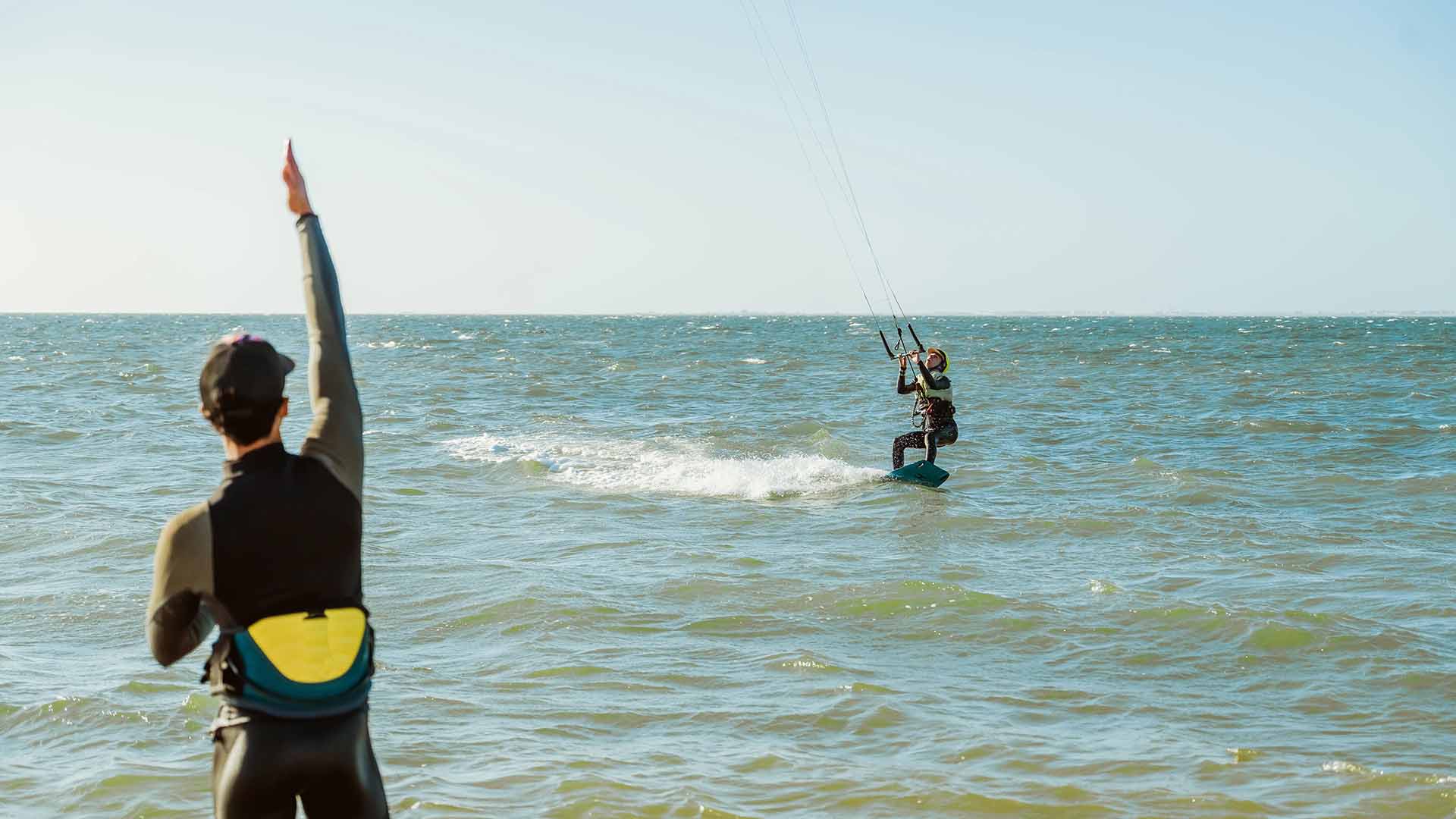
Finally, make sure you know your safety procedures, especially how to use your kite’s quick-release system, and progress one step at a time. This is where having an instructor makes a real difference. With radio coaching, they can give you instant feedback, correct the small details that make the technique click, and stop bad habits from setting in. Learning to jump with an instructor is by far the fastest and safest way to progress.

WHICH JUMPS SHOULD YOU TRY AFTER THE BASIC JUMP?
Once you have the basic jump and can land it cleanly, a whole new world opens up. From there, the usual progression is to move from easier tricks to more challenging ones.
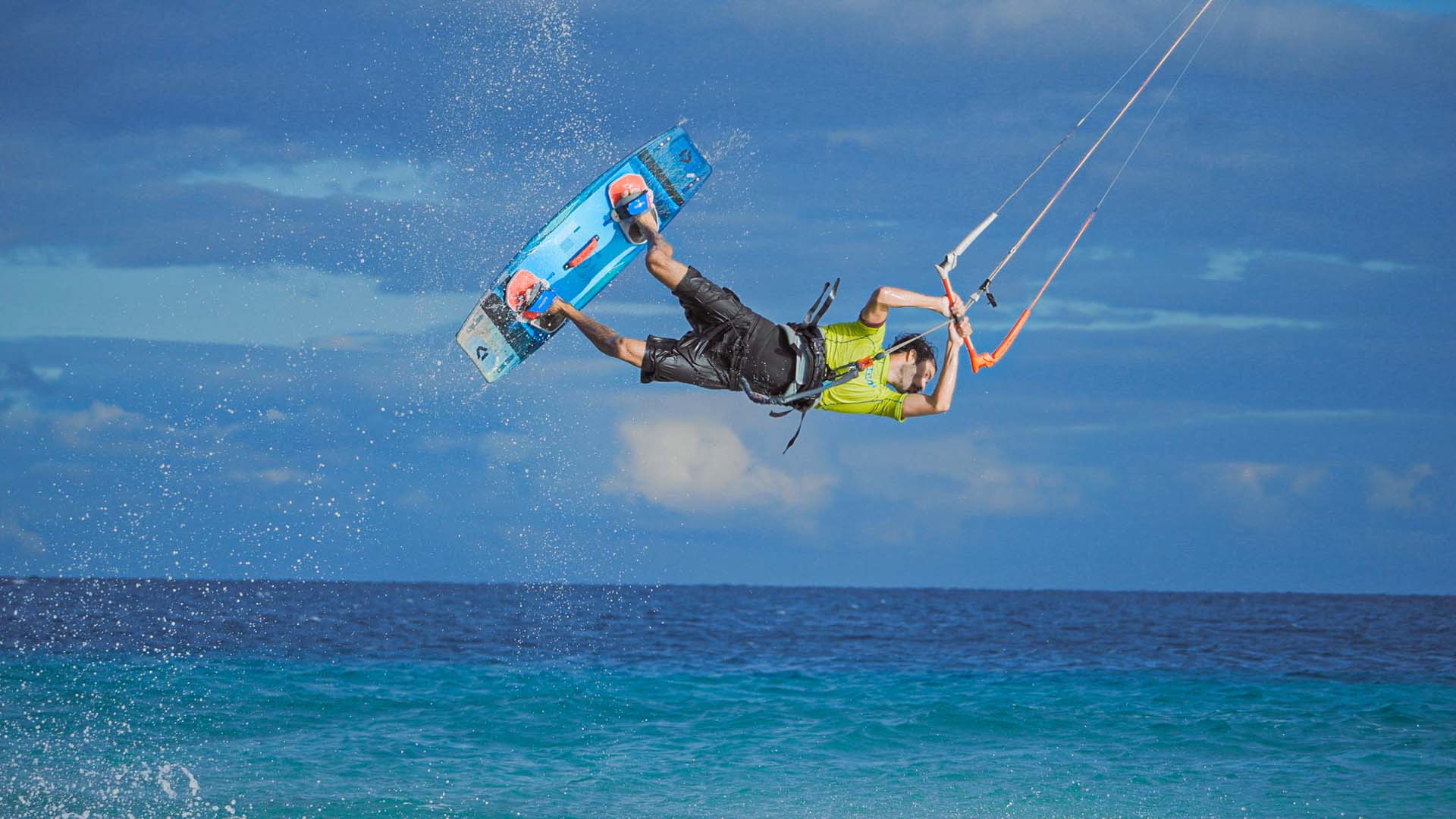
A natural next step is the jump transition, where you change direction in the air and ride away the other way. It is a really useful move and feels great when you get it right. Next up is the backroll, a backward rotation that is relatively easy to learn and a lot of fun. If you want to add more style, you can also start working on tic-tacs and your first grabs, reaching down to grab the board while you are in the air. All of these tricks build on the solid foundations you developed with your first jumps.
The key is not to rush things. Take each new trick step by step, ideally with an advanced lesson and in the right conditions. That is how you develop smooth, consistent technique instead of simply collecting crashes.
Ready to get some air safely and progress faster with the right coaching?
FAQ
AT WHAT LEVEL CAN YOU START JUMPING?
You can start jumping once you can ride upwind comfortably, ride in control in both directions, and reliably bring the kite to 12 o’clock. Before you have these skills dialled in, jumping is more likely to result in hard or uncontrolled landings.
DO YOU NEED A BIG KITE TO JUMP HIGHER?
No, and it is actually a common mistake. An oversized kite can pull you too hard and lead to heavy landings. It is better to use the right kite size for the wind conditions and focus on clean technique. The height will come as your technique improves.
IS JUMPING IN KITESURFING DANGEROUS?
When you have the right skills, choose a suitable spot, use the right kite, and learn with proper instruction, the risks are greatly reduced. A smooth, controlled landing by redirecting the kite is key to staying safe.
HOW LONG DOES IT TAKE TO LAND YOUR FIRST JUMP?
KITESURFING LESSON: WHAT TO EXPECT FROM YOUR FIRST SESSION
KITESURFING LESSON: WHAT HAPPENS DURING YOUR FIRST SESSIONBooking your first kitesurfing lesson often comes with the same questions. Will I go straight into the water? Is it dangerous? How long will it take before I can stand up on the board? To give you a clear idea...

THE STORY OF A KITE AND WING CRUISE IN THE CARIBBEAN
Caribbean Kite Cruise: Thaïs' Story from the GrenadinesThaïs, 25, works as a travel consultant in the ION CLUB Holidays team. She recently went on a kitesurfing and wingfoiling cruise in the Grenadine Islands in the Caribbean. The trip was a mix of kite and wingfoil...

KITESURF LESSONS IN TARIFA: PROGRAMME AND PROGRESSION
Kitesurf Lessons in Tarifa: Program and Progression at ValdevaquerosTarifa has earned a unique reputation in the world of kitesurfing. Located at the southern tip of Andalusia, facing the Strait that separates Europe from Morocco, the town enjoys reliable wind almost...