
IKO AND VDWS CERTIFICATIONS: UNDERSTANDING KITESURFING LEVELS
When you’re looking for a kitesurfing school, two names come up again and again: IKO and VDWS. They are the two main international standards for kitesurfing instruction. Understanding what they stand for helps you in two ways: choosing a reputable school and knowing where your own skills fit within a structured progression system that is recognized worldwide.
In this guide, we explain what IKO and VDWS are, how the student and instructor levels are structured, what the differences are between the two systems, and why these certifications make a real difference to the quality and safety of your learning experience.
WHAT ARE IKO AND VDWS CERTIFICATIONS?
IKO, which stands for International Kiteboarding Organization, and VDWS, short for Verband Deutscher Wassersport Schulen, a German water sports organization, are two international systems that standardize kitesurfing instruction. In practice, they define a common teaching method, a level-based progression system, and a set of skills that affiliated schools follow around the world.
There are two main benefits for you. First, a certified school commits to following established safety and teaching standards. Second, your level is recognized from one center to another: if you are certified at a certain level, you can go to any affiliated center and continue from the right stage. It works like an international passport for your kitesurfing progression.
WHAT ARE THE STUDENT LEVELS IN KITESURFING?
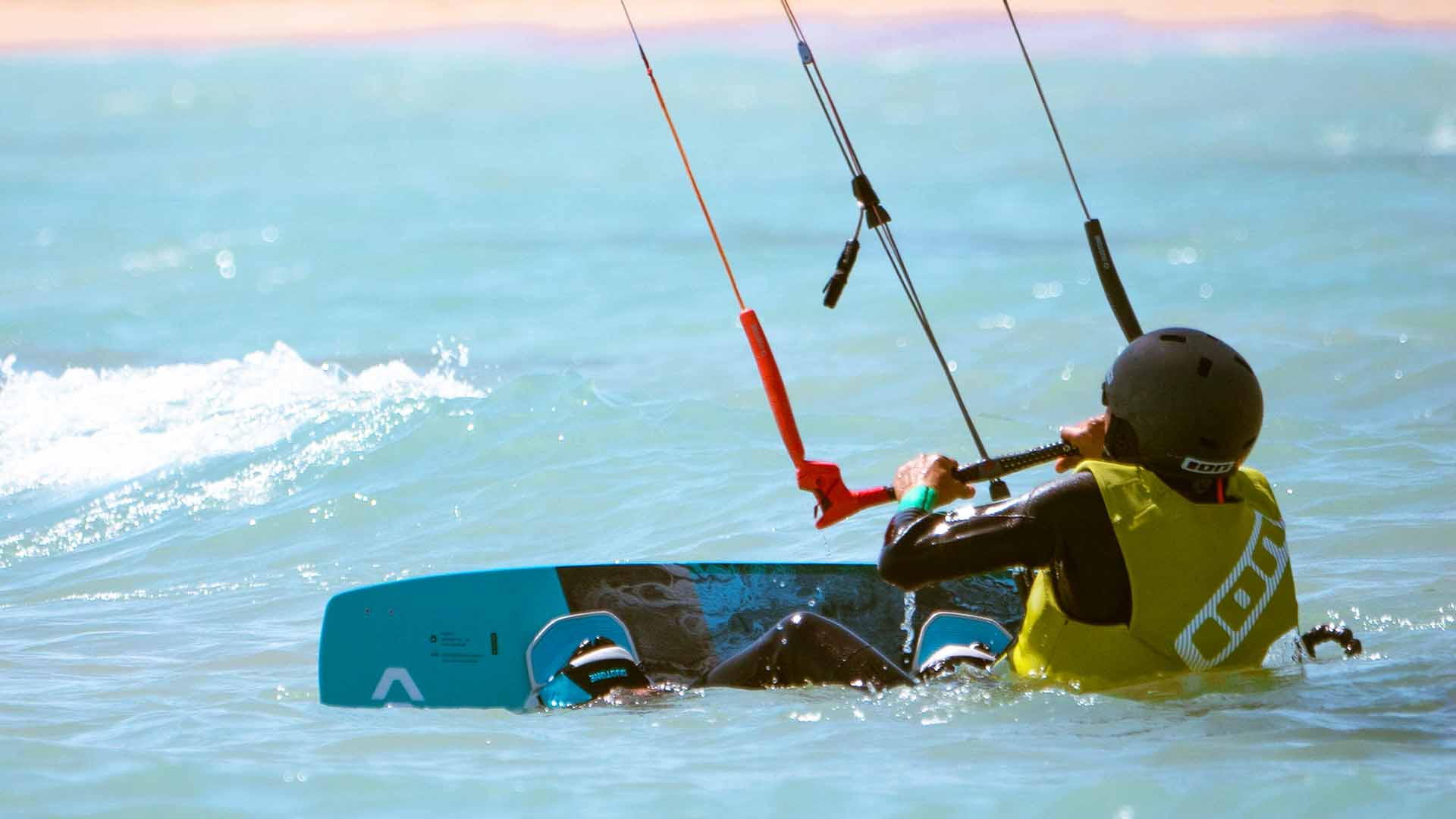
The student progression follows a clear path, from complete beginner to independent rider. With IKO, it goes from Level 1, Discovery, to Level 4, Advanced. Each stage confirms specific skills before you move on to the next one.
At the Discovery level, you learn about the wind window, how to control the kite on land, and the basics of safety. At the intermediate levels, you move into the water, master the waterstart, learn to ride upwind, and ride controlled runs in both directions. The Advanced level confirms that you are truly independent: you can ride upwind confidently, perform transitions, start jumping, and handle recovery procedures.
Level 4 is especially important because it is a prerequisite for instructor training. Among other things, you need to be able to perform a transition jump, a jump with a grab, a jibe, recover a rider and a board in difficulty, and understand right-of-way rules, equipment, weather, and tides. Reaching this level means becoming a safe rider.

WHAT ARE THE KITESURFING INSTRUCTOR LEVELS?
The instructor pathway is just as structured. You generally start as an assistant instructor after completing specific training, before becoming a fully qualified instructor and then progressing through the different levels. With IKO, there are Level 1, 2, and 3 instructors, with each level increasing the number of students and kites they are allowed to supervise at the same time.
In practice, a newly qualified instructor teaches a very small number of students with only one kite in the air, ensuring close supervision and maximum safety. As instructors progress through the levels, and with the support of assistants, they can supervise more students. For example, a Level 3 instructor can supervise up to eight students and four kites in the air with two assistants. These higher levels require extensive experience, measured in hundreds of students taught and thousands of teaching hours, as well as passing specific exams.
These levels give you a clear idea of the quality of the instruction you can expect. A low student-to-instructor ratio, such as the private or semi-private lessons we prefer, means more individual attention and faster progress.

ARE THESE CERTIFICATIONS ENOUGH TO TEACH IN FRANCE?
This is an important point to know, especially if you’re thinking about teaching one day. Internationally, an IKO or VDWS certification allows instructors to work in affiliated centers around the world. In France, however, paid kitesurfing instruction is regulated and requires a state-recognized qualification.
In other words, IKO and VDWS are recognized standards for teaching abroad, but on their own they are not enough to teach professionally in France, where the relevant French state qualification is also required. For you as a student taking lessons at an international center while traveling, this makes no difference: your instructor’s IKO or VDWS certification is exactly the standard you should expect.
WHY DO THESE CERTIFICATIONS MATTER FOR YOU?
When booking your lessons, checking that the school is certified is an important step. An IKO- or VDWS-certified school gives you a structured teaching method, trained instructors, suitable equipment, and proven safety procedures. It’s the difference between learning in a professional environment and an improvised approach that could put your safety at risk.
Certification also gives you a clear path to follow. You know where you are in your progression, which skills you still need to develop, and how to move on to the next level at any affiliated center around the world. Your progress becomes easy to track, transferable, and motivating. That’s the real advantage of learning within a recognized system rather than simply figuring things out as you go.
Ready to learn with certified instructors and a proven teaching method? Discover our kitesurfing lessons
FAQ
WHICH IS BETTER, IKO OR VDWS?
Both offer equally high standards and international recognition. IKO is more widely used around the world, while VDWS originated in Germany and is recognized by sailing federations. What matters most is that the school is affiliated with one of these recognized organizations.
HOW MANY LEVELS DO YOU NEED TO COMPLETE TO KITESURF INDEPENDENTLY?
Being independent generally corresponds to the advanced level, Level 4 with IKO. At this stage, you can ride upwind, perform transitions, and handle recovery procedures on the water.
IS MY CERTIFICATION RECOGNIZED AT ALL CENTERS?
Yes. That’s one of the main benefits of these systems: your level is recognized from one affiliated center to another around the world, so you can continue your progression without having to start from scratch.
DO YOU NEED TO BE CERTIFIED TO RENT KITESURFING EQUIPMENT?
Many centers ask you to prove that you can kitesurf independently before renting equipment, mainly for safety reasons. A recognized certification makes it easier to rent gear by providing proof of your skills.

SAL OR TARIFA: WHEN TO GO FOR THE WIND?
Sal or Tarifa: Where to Go Depending on the Season to Never Miss the Wind?There is one question every rider eventually asks: where should you go to be sure you’ll have wind? If you practice kitesurfing, wingfoiling, or windsurfing, two destinations naturally stand out...

RENTAL OR STORAGE ?
Bringing Your Own Equipment or Renting on Site: The Kitesurfing, Windsurfing, and Wingfoiling DilemmaIt’s the big question before every trip: should you bring your own gear or rent when you arrive? Riding with your favorite board sounds great, but traveling with...

PACKAGES GOLF DE ROSES
FROM APRIL 13TH TO MAY 31TH 2026, ENJOY -10% ON YOUR STAY AT ION CLUB GOLF DE ROSES BUNGALOW // ACTIVITY Our exclusive 7-night / 8-day packages offer you much more than just a stay. Under the Catalan sun of the Golf de Roses, immerse yourself in the world of...