
KITESURF CAMP: ONE OR TWO WEEKS, WHICH LENGTH SHOULD YOU CHOOSE?
When booking a kitesurf course, the same question always comes up: is one week enough, or should you plan for two weeks to really make progress? It might seem natural to think in terms of weeks, but that’s exactly where many riders go wrong. The length of a kitesurf course isn’t about the number of days on the calendar, but about the actual hours spent on the water.
This guide explains why thinking in hours makes all the difference, how many hours you’ll need to reach the main learning goals, and how to choose the right course length based on your level and the spot. That way, you can avoid booking a course that’s too short or paying for days when there is no wind.
SHOULD YOU THINK IN DAYS OR IN HOURS OF LESSONS?
Hours, without a doubt. A one-week kitesurf course doesn’t guarantee progress: it all depends on how many actual lesson hours you get. Two people can book the same week and make very different progress simply because one spends ten hours on the water while the other only gets three.
There are two main reasons for this difference. First, the wind: at a spot with unreliable conditions, you might have several days in a week when you can’t get on the water at all. That’s why choosing a windy spot makes such a difference. If the wind blows almost every day, you can turn more of your time there into actual practice hours. Second, the lesson format: an hour of private or semi-private lessons is much more valuable than an hour in a large group, where your individual practice time is much more limited. So think in terms of actual hours on the water, not simply the number of days you’re there.
HOW MANY HOURS DO YOU NEED TO LEARN KITESURFING OR BECOME INDEPENDENT?
A few general guidelines can help you choose the right amount of lesson time, although this will vary depending on the wind, your fitness level, how comfortable you are in the water, and how regularly you practice. To discover kitesurfing and learn the basics, including kite control, safety, and your first experience on the water, allow around six hours of lessons. That’s enough for a proper introduction to the sport, giving you a feel for kitesurfing and helping you develop your first key skills.
To become an independent kitesurfer, meaning you can ride upwind, link transitions, and perform a self-rescue, aim for around twelve hours of lessons. At this point, a motivated rider taking private or semi-private lessons can start riding independently. Beyond that, every extra hour helps you build confidence, improve your skills, and start working on your first jumps and style.
Keep in mind that everyone learns at a different pace. Some people may need more time to become independent, while others may need fewer hours.
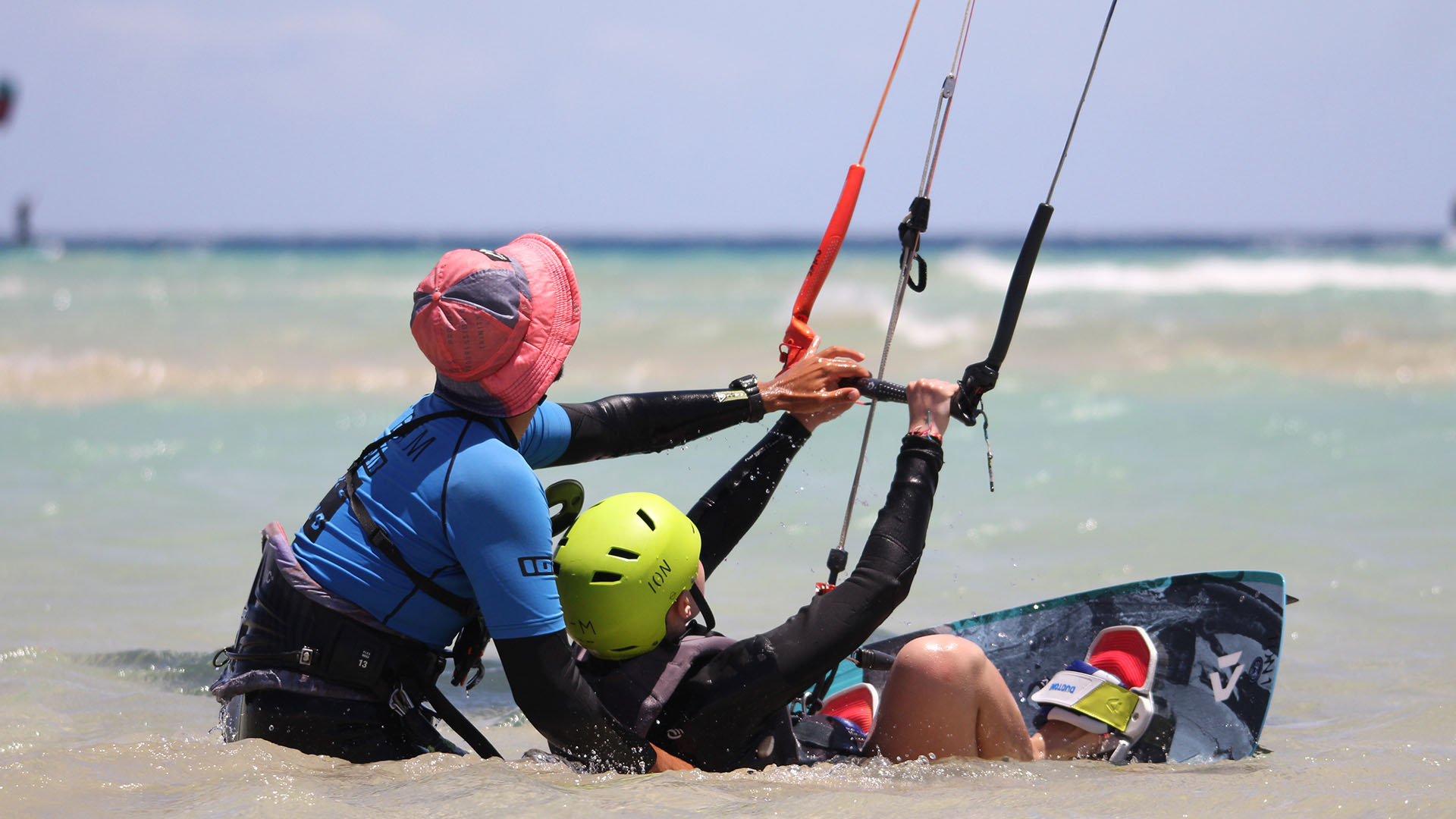

SO, ONE OR TWO WEEKS FOR A KITESURF CAMP?
It all depends on your goal and how many hours you can realistically spend on the water during your stay. If you’re a beginner and want to learn the basics, one week at a windy spot, with enough lesson hours, is often enough to get your first sensations and build solid skills.
If your goal is to become fully independent, or if you’re heading to a spot where the wind is less reliable, two weeks give you some valuable extra time. This allows you to make up for any no-wind days, get enough hours on the water, and progress without rushing. If you want to come away able to kitesurf independently, two weeks give you a better chance of reaching that goal, while one week can be a little tight, especially if the weather doesn’t cooperate. A good rule of thumb is to give yourself some leeway and plan for slightly more lesson time than the bare minimum, so your progress doesn’t depend entirely on the weather.
WHAT FACTORS MATTER JUST AS MUCH AS THE LENGTH OF YOUR KITESURF TRIP?
The length of your kitesurf trip is only one part of the equation. Several other factors can have just as much, if not more, impact on your progress.
- How reliable the wind is at the spot, as this determines how many hours you can actually spend on the water during your stay.
- The lesson format. Private or semi-private lessons give you much more individual practice time than lessons in a large group.
- Consistency. Having your sessions close together, without long breaks of several days, helps you build on what you’ve learned instead of losing progress between sessions.
- Your fitness level and how comfortable you are in the water, both of which can affect how quickly you learn.
Our advice: start by choosing a windy spot and private or semi-private lessons, then decide how long to stay based on the number of hours you need to reach your goal. A well-planned one-week camp at a reliable spot is often better than two weeks somewhere with unpredictable wind.
Need help choosing the right lesson format for your kitesurf trip?
👉 Discover our kitesurf lessons and camps or chat with us to find the right option for you.
FAQ
IS ONE WEEK ENOUGH TO LEARN KITESURFING?
Yes, if your goal is to discover the sport and learn the basics, as long as you get enough hours on the water at a windy spot. Allow around six hours for an introduction to kitesurfing and around twelve hours if your goal is to become independent.
HOW MANY HOURS OF LESSONS DO YOU NEED TO BECOME INDEPENDENT?
Around twelve hours of private or semi-private lessons for a motivated rider, although this can vary depending on the wind, your fitness level, and how regularly you practice.
WHY THINK IN HOURS RATHER THAN DAYS?
Because a week can include days with no wind, and your actual practice time also depends on the lesson format. Two riders spending the same week at a spot can make very different progress depending on how many hours they actually spend on the water.
IS IT BETTER TO SPEND TWO WEEKS AT A SPOT WITH UNRELIABLE WIND OR ONE WEEK AT A WINDY SPOT?
Often, one full week at a spot with reliable wind is the better choice. Consistent wind means more hours on the water, while at a less reliable spot, you could lose several days to poor conditions, even over a longer stay.
IKO AND VDWS CERTIFICATIONS: UNDERSTANDING KITESURFING LEVELS
IKO AND VDWS CERTIFICATIONS: UNDERSTANDING KITESURFING LEVELSWhen you’re looking for a kitesurfing school, two names come up again and again: IKO and VDWS. They are the two main international standards for kitesurfing instruction. Understanding what they stand for...
KITESURF RENTAL OR LESSONS: WHAT LEVEL DO YOU NEED TO RIDE ON YOUR OWN?
Before going any further, one important point: at ION CLUB, we don’t rent equipment to riders who aren’t able to kite independently. This isn’t just a recommendation, it’s a safety rule we always follow. If you have a recognized certification (an IKO or VDWS card...

KITESURF & WINGFOIL CAMP MATHIEU
WITH MATHIEU PASTORINO 3–10 APRIL 2027 • OASIS212 • 6 TO 12 PARTICIPANTSTHE PROGRAM Saturday 03/04 – Arrival in Dakhla and transfer to Oasis212 From Sunday 04/04 to Friday 09/046 days of riding, coaching and excursions3 days of excursions, depending on the windthe...